


Episode:
92

Wolsong-1 (CANDU 6)
Country:
South Korea
Years of Operation:
1983-2019
Category:
Commercial & Power
Reactor Type:
CANDU
Coolant:
Heavy Water
Fuel Type:
Natural Uranium
Moderator:
Heavy Water
Thermal Power (MWth):
2064
Electrical Power (MWe):
2064
Status:
Commercial & Power

timeline
First Criticality Year
1982
Commercial Op Year
1983
Shutdown Year
2019


Lessons Learned
1. Operational Readiness Starts Years Before Fuel Load
Most FOAK teams treat operations like a Phase 5 activity—something you stand up when construction is “mostly done.”Wolsong didn’t do that.
They embedded Korean staff during construction and commissioning, shoulder-to-shoulder with AECL and Ontario Hydro. They weren’t waiting to run the plant—they were learning how it behaves when it’s still being built.
That matters.
Because the plant you inherit on Day 1 isn’t the one in the design package—it’s the one shaped by thousands of field decisions.
Lesson:If your operators aren’t in the room during construction and commissioning, you are training them on a plant that no longer exists.
2. Borrow Competence Relentlessly — Then Internalize It
Wolsong-1 was turnkey. AECL and Ontario Hydro brought a mature operating culture with them.
Korea didn’t fight that. They absorbed it.
Quietly. Methodically. Without ego.
Then they did something most FOAK programs never quite pull off:They converted borrowed excellence into internal capability.
By Wolsong 2–4, this wasn’t a Canadian plant in Korea anymore.It was a Korean-operated fleet.
Lesson:FOAK success isn’t about proving you’re smart.It’s about importing proven excellence—and then making it your own.
3. Big “O” Operations Wins — Not Just Control Room Performance
A lot of FOAK teams obsess over the control room: HMI, automation, staffing models.
That’s little o.
Wolsong succeeded because of big O:
Maintenance that actually closes work orders on time
Chemistry that keeps the plant stable, not just compliant
Radiation protection that enables work instead of slowing it down
Engineering that resolves issues quickly instead of studying them forever
Capacity factor doesn’t come from clever control room design.It comes from everything working together without friction.
Lesson:You don’t get 86%+ capacity factor from operators alone.You get it from a fully functioning operating organization.
4. Standardization Beats Innovation in FOAK Operations
Nothing about Wolsong-1’s success was flashy.
It wasn’t bleeding-edge.It wasn’t trying to reinvent operations.It was disciplined, repeatable, and boring—in the best possible way.
Meanwhile, a lot of FOAK developers today are trying to:
Redesign staffing models
Eliminate traditional departments
Replace procedures with “AI assistance”
Run lean before they’ve ever run stable
That’s backwards.
Lesson:FOAK is not the time to experiment with how nuclear plants are operated. It’s the time to execute a proven model—cleanly and consistently.
5. Performance Is Cultural Before It’s Technical
Here’s the uncomfortable truth:
Wolsong-1 didn’t outperform because CANDU is magic.It outperformed because the organization running it was disciplined.
Three consecutive cycles over 330 days. One at 455 days.That’s not design—that’s behavior:
Conservative decision-making
Strong ownership at the department level
Low tolerance for unresolved issues
Pride in performance
Most FOAK teams underestimate this because culture doesn’t show up in a P&ID.
But it shows up in your capacity factor.
Lesson:If your culture isn’t built for high performance, your reactor won’t be either—no matter how good the design looks on paper.
sources

ARTICLE

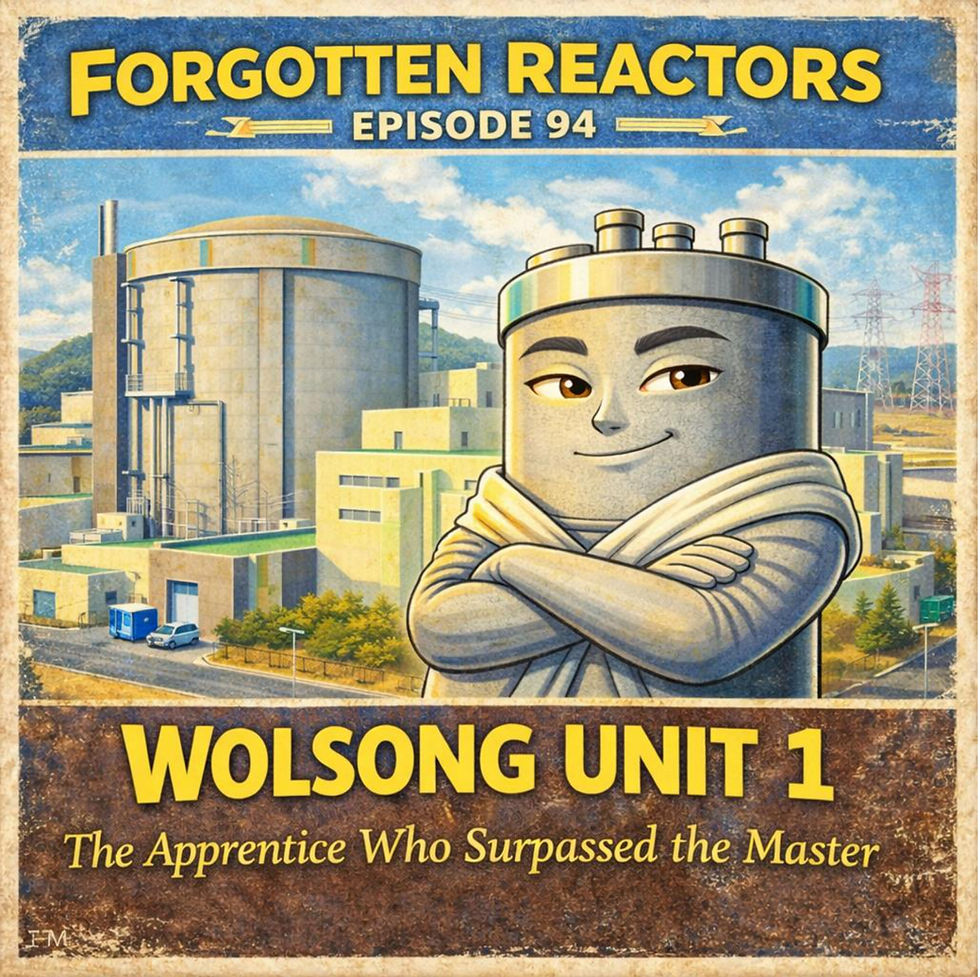
Wolsong-1 — The Korean FOAK CANDU That Worked (Forgotten Reactors #94)
In the 1970s, most countries shopping for their first nuclear program just took what Westinghouse or GE was selling. South Korea bought the Westinghose reactors — Kori-1 and Kori-2 — but then also bought a CANDU 6 from Canada.
Which is a weird move. A really weird move.
Or it looked weird at the time.
The turnkey construction started in 1977. Wolsong-1 came online in April 1983. 2,061 MWth. 678 MWe gross. A medium sized machine.
Why a CANDU?
Korea wanted indigenous nuclear capability. Washington didn't love that idea — especially when Park's team started sniffing around French reprocessing plants in the early '70s.
The U.S. basically said “no, you can’t,” and Korea backed off. So, when you're building a nuclear program under that kind of pressure, buying a reactor that runs on natural uranium and doesn't need enrichment is less of a technical choice and more of a survival instinct. You're not dependent on fuel supply chains you don't control.
Wolsong-1 wasn't some miraculous piece of engineering handed to a ready operator. It was a turnkey job — AECL ran the show, Ontario Hydro managed commissioning. Korea showed up and learned. Like an apprentice who keeps quiet, watches everything, and takes very good notes.
REALLY good notes.
The numbers, though — that's the part nobody talks about.
While the US fleet was averaging around 57% capacity factor in the mid-1980s, Wolsong-1 hit a lifetime capacity factor over 35 years of 86.2 percent.
The US fleet didn't cross 70% until 1991. Wolsong was already embarrassing them.
Three consecutive trouble-free operating cycles early on. Each one over 330 days. The last hit 455 days. On more than one occasion, Wolsong-1 ranked first in the world annually. With a FOAK reactor. In a country still building its industrial base. Running circles around the American fleet like a student who showed up and outscored the professor.
So Korea went back to Canada and bought three more.
By the late 1990s, they had four CANDUs running at Wolsong with substantially more Korean hands on the controls. Fast forward three decades and they're exporting a $28 billion APR-1400 nuclear package to the UAE. You don't get there without the first reactor working. And working well.
Running two totally different reactor designs simultaneously looks like chaos — like showing up to a potluck with two completely different dishes nobody asked for. It's actually what you do when you're serious about not being dependent on a single vendor, fuel cycle, or design school.
It's a hedge. And it worked.
Wolsong-1 ran for 35 years. Not perfect. Not without issues. But solid.
Wolsong-1 didn’t succeed because it was a CANDU. It succeeded because it had a high performing operating organization long before the US fleet understood what that phrase meant.
FOAK plants don’t fail because of physics.
They fail because the organization isn’t ready.
Wolsong proved the opposite is possible.
#ForgottenReactors #NuclearEnergy #CANDU #SouthKorea #NuclearHistory #EnergyPolicy
LESSONS LEARNED — WOLSONG-1 (FOAK DONE RIGHT)
1. Operational Readiness Starts Years Before Fuel Load
Most FOAK teams treat operations like a Phase 5 activity—something you stand up when construction is “mostly done.”Wolsong didn’t do that.
They embedded Korean staff during construction and commissioning, shoulder-to-shoulder with AECL and Ontario Hydro. They weren’t waiting to run the plant—they were learning how it behaves when it’s still being built.
That matters.
Because the plant you inherit on Day 1 isn’t the one in the design package—it’s the one shaped by thousands of field decisions.
Lesson:If your operators aren’t in the room during construction and commissioning, you are training them on a plant that no longer exists.
2. Borrow Competence Relentlessly — Then Internalize It
Wolsong-1 was turnkey. AECL and Ontario Hydro brought a mature operating culture with them.
Korea didn’t fight that. They absorbed it.
Quietly. Methodically. Without ego.
Then they did something most FOAK programs never quite pull off:They converted borrowed excellence into internal capability.
By Wolsong 2–4, this wasn’t a Canadian plant in Korea anymore.It was a Korean-operated fleet.
Lesson:FOAK success isn’t about proving you’re smart.It’s about importing proven excellence—and then making it your own.
3. Big “O” Operations Wins — Not Just Control Room Performance
A lot of FOAK teams obsess over the control room: HMI, automation, staffing models.
That’s little o.
Wolsong succeeded because of big O:
Maintenance that actually closes work orders on time
Chemistry that keeps the plant stable, not just compliant
Radiation protection that enables work instead of slowing it down
Engineering that resolves issues quickly instead of studying them forever
Capacity factor doesn’t come from clever control room design.It comes from everything working together without friction.
Lesson:You don’t get 86%+ capacity factor from operators alone.You get it from a fully functioning operating organization.
4. Standardization Beats Innovation in FOAK Operations
Nothing about Wolsong-1’s success was flashy.
It wasn’t bleeding-edge.It wasn’t trying to reinvent operations.It was disciplined, repeatable, and boring—in the best possible way.
Meanwhile, a lot of FOAK developers today are trying to:
Redesign staffing models
Eliminate traditional departments
Replace procedures with “AI assistance”
Run lean before they’ve ever run stable
That’s backwards.
Lesson:FOAK is not the time to experiment with how nuclear plants are operated. It’s the time to execute a proven model—cleanly and consistently.
5. Performance Is Cultural Before It’s Technical
Here’s the uncomfortable truth:
Wolsong-1 didn’t outperform because CANDU is magic.It outperformed because the organization running it was disciplined.
Three consecutive cycles over 330 days. One at 455 days.That’s not design—that’s behavior:
Conservative decision-making
Strong ownership at the department level
Low tolerance for unresolved issues
Pride in performance
Most FOAK teams underestimate this because culture doesn’t show up in a P&ID.
But it shows up in your capacity factor.
Lesson:If your culture isn’t built for high performance, your reactor won’t be either—no matter how good the design looks on paper.
SLIDE DECK


