


Episode:
61

Winfrith SGHWR
Country:
UK
Years of Operation:
1968-1990
Category:
Research & Experimental
Reactor Type:
Coolant:
Light Water / Steam
Fuel Type:
Enriched Uranium
Moderator:
Heavy Water
Thermal Power (MWth):
100
Electrical Power (MWe):
100
Status:
Research & Experimental
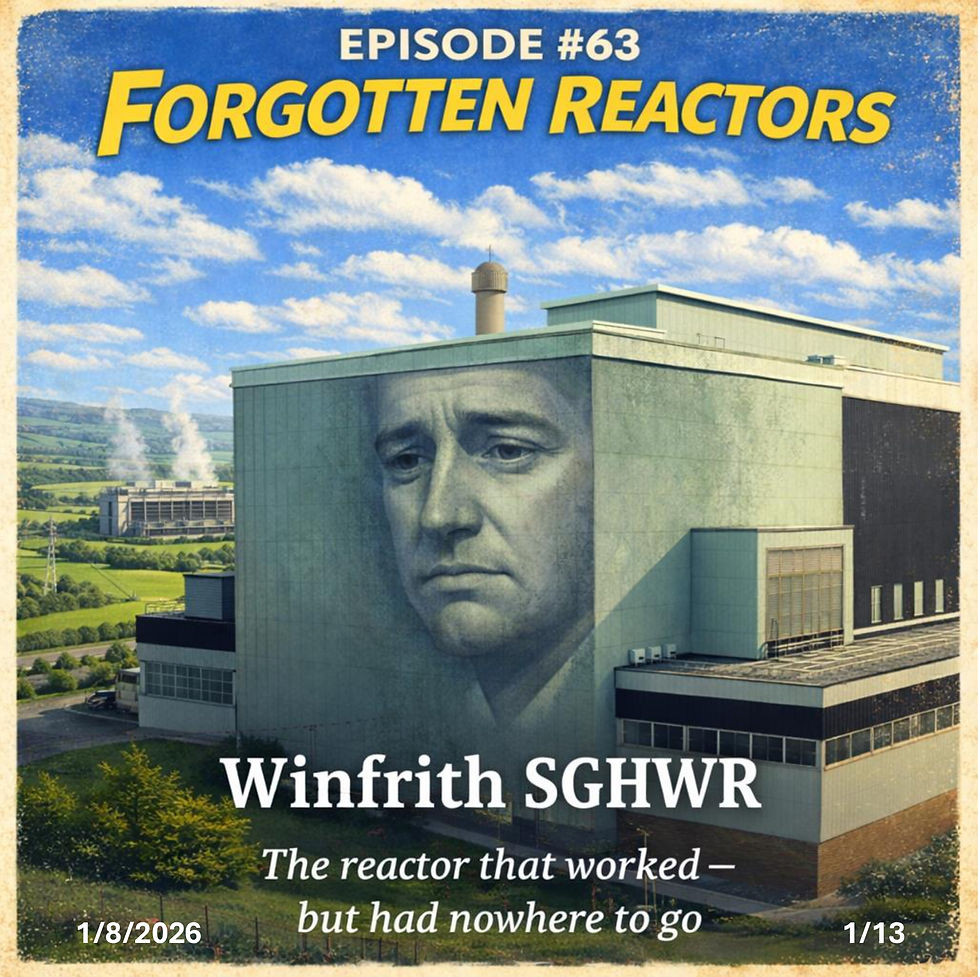_page-0001.jpg)

timeline
First Criticality Year
1967
Commercial Op Year
1968
Shutdown Year
1990
Lessons Learned
• Engineering elegance does not guarantee adoption
• Reactor success depends on ecosystem alignment, not just performance
• Orphan technologies struggle, even when they work
• Nuclear history remembers failures — and forgets quiet successes
Winfrith SGHWR is a reminder that in nuclear power, survival favors designs that fit the
system, not just the equation.
sources

ARTICLE

When people talk about Britain’s nuclear history, the story usually jumps from Calder Hall straight to AGRs, with a side note on fast reactors at Dounreay. What almost never gets mentioned is the Steam Generating Heavy Water Reactor (SGHWR) at Winfrith — a design that quietly did its job, proved its concept, and then slipped out of history without drama.
Construction of Winfrith SGHWR began in 1963, during a period when the UK was still genuinely exploring multiple nuclear pathways. The reactor achieved first criticality in 1967 and entered power operation soon after. This was not a paper reactor or a short-lived experiment.
It ran, it behaved, and it delivered exactly what the designers said it would.
From an engineering standpoint, SGHWR was genuinely clever. It used heavy water (D₂O) as a moderator and boiling light water as coolant, arranged in pressure tubes rather than a single
large pressure vessel. That combination delivered excellent neutron economy, lower operating pressure than conventional BWRs, and straightforward steam generation. It also sidestepped the need for massive forged reactor vessels — no small consideration in the 1960s.
Thermal output was on the order of 100 MWt, producing roughly 20–25 MWe of electrical power. Modest, yes — but appropriate for a prototype whose real mission was validation, not grid dominance. Operationally, the reactor accumulated years of service with no headline-grabbing incidents. In nuclear terms, that’s success.
So why did it disappear?
Because nuclear power doesn’t live or die on physics alone.
By the late 1960s, the UK had already committed politically and industrially to gas-cooled reactors. SGHWR required a dedicated heavy-water supply chain, specialized training, and a
fleet strategy that never materialized. Export interest existed, but without a domestic reference fleet or long-term industrial backing, SGHWR became an elegant solution with no ecosystem to
support it.
In short, it worked — but it belonged to no tribe.
The reactor was permanently shut down in 1990, not because it failed, but because it no longer fit Britain’s strategic direction. Decommissioning followed quietly and methodically. Today, the Winfrith site is fully decommissioned, its reactor dismantled and returned to non-nuclear use — a remarkably calm ending for a successful reactor.
SLIDE DECK


