


Episode:
91

Thorium - The Fuel That Almost Arrived
Country:
Years of Operation:
Category:
Special Topics
Reactor Type:
Coolant:
Fuel Type:
Moderator:
Thermal Power (MWth):
Electrical Power (MWe):
Status:
Special Topics

timeline
First Criticality Year
Commercial Op Year
Shutdown Year


Lessons Learned
sources

ARTICLE

Forgotten Reactors Series #93 (Special Edition)
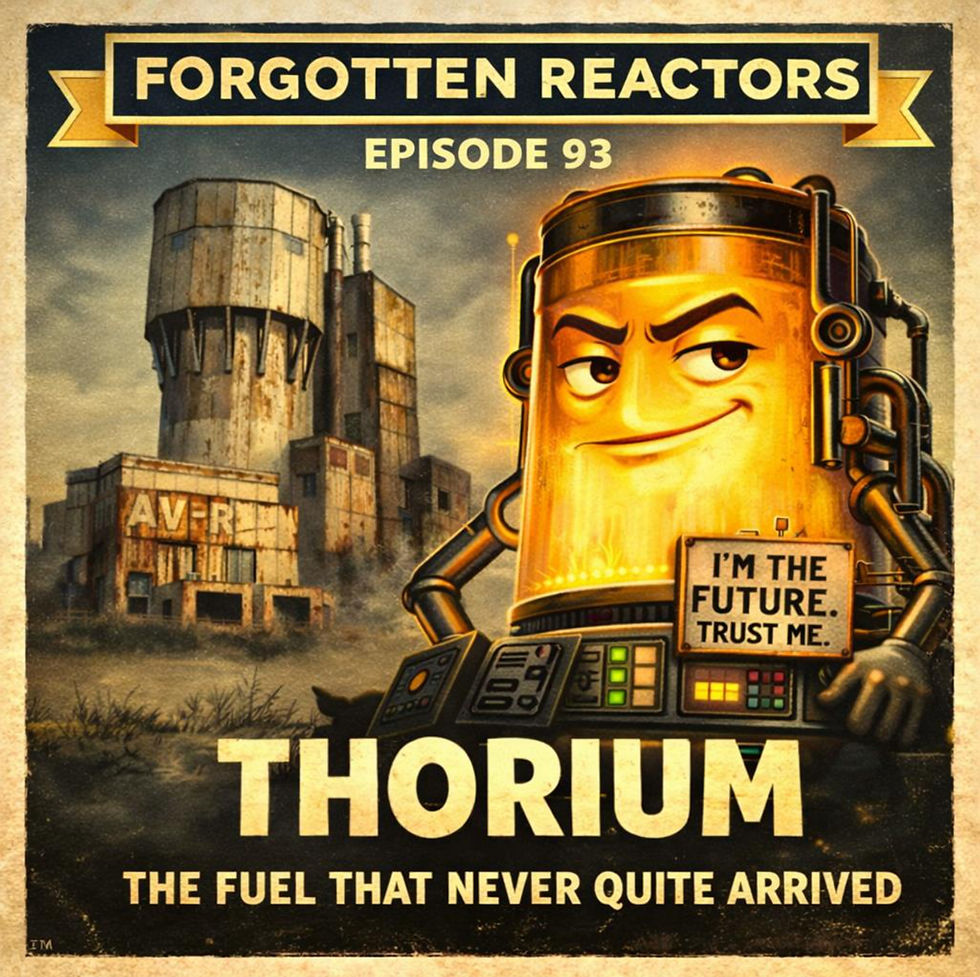
Thorium — The Fuel That Never Quite Arrived
Every few years, thorium comes back.
A new article.A new startup.A new wave of enthusiasm explaining why this time, finally, it’s going to change everything.
And every time I hear the same claim:
“Thorium is safer. More abundant. Produces less waste. It’s the future of nuclear energy.”
So let me ask a simple question—one that doesn’t require a PhD to answer:
If thorium is so superior… where are the reactors?
Not test loops.Not pilot concepts.Not PowerPoint.
Operating plants. At scale.
Because in this business, that’s the only scoreboard that matters.
Thorium has always been a beautiful idea.
But it comes with a catch most people gloss over:
Thorium isn’t fuel. It’s fertile material.
To make it work, you have to create your fuel (U-233) inside the reactor, and then manage a chain of side effects that sound manageable on paper and get very real very quickly:
Protactinium management
U-232 contamination (and its hard gamma emissions)
Online or semi-online chemical processing
At that point, you didn’t simplify nuclear power.
You added a fuel reprocessing plant to the reactor.
Now layer in the reality that actually determines what gets built:
We have a mature, global infrastructure for uranium:
Mining
Conversion
Enrichment
Fuel fabrication
Licensing frameworks
60+ years of operating data
For thorium?
We have:
Experimental programs
A handful of demonstration efforts
Decades of “almost ready”
Even India—the most committed thorium program in the world—has been working the problem for generations.
That’s not a criticism.
That’s a signal.
Then there’s the issue that quietly kills most advanced fuel concepts:
Fuel qualification.
UO₂ fuel didn’t become dominant because it was exciting.
It became dominant because it worked, repeatedly, under real operating conditions, across tens of thousands of reactor-years.
Thorium-based fuels don’t have that track record.
Not even close.
And in nuclear, what you don’t know will eventually find you.
There’s also a pattern here that should feel familiar.
We’ve seen technologies that look outstanding on paper:
Liquid sodium fast reactors
High-temperature gas designs
TRISO-based fuel systems
All elegant. All defensible. All backed by smart people.
And all… still climbing the reliability and cost curve decades later.
Thorium risks falling into the same category:
Technically compelling. Commercially elusive.
And that brings us to the part that doesn’t get talked about enough:
Nuclear power is a business. It is not a religion.
Utilities don’t buy elegance.
They buy:
Proven performance
Predictable cost
Licensable designs
Fuel they can actually procure
Thorium, today, struggles on every one of those dimensions.
None of this means thorium has no future.
It might.
There are smart people working the problem, and some of the underlying physics is genuinely attractive.
But we’ve been hearing “thorium is the future” for a long time now.
And the future has a way of arriving… or not.
Thorium may still have a future.But nuclear history is littered with technologies that looked inevitable—like liquid sodium—right up until they weren’t.
SLIDE DECK


