


Episode:
93

Pégase
Country:
France
Years of Operation:
1963-1965
Category:
Research & Experimental
Reactor Type:
Coolant:
Organic (Santowax)
Fuel Type:
Enriched Uranium
Moderator:
Organic Liquid
Thermal Power (MWth):
30
Electrical Power (MWe):
30
Status:
Research & Experimental
_page-0001.jpg)

timeline
First Criticality Year
1963
Commercial Op Year
Shutdown Year
1965


Lessons Learned
. Independence sounds romantic, but economics win.
Chasing self-sufficiency with natural uranium looked smart geopolitically in the '60s.
But higher staffing, tricky chemistry, and derated performance made UNGG expensive at scale.
PWRs scaled better, cost less to run, and were easier to export—France pivoted fast.
2. Test reactors are worth every franc when you're committed.
PEGASE (and PEGGY) gave rock-solid fuel data before full-scale plants were online.
That kind of targeted irradiation testing prevented nasty surprises down the line.
Even if the program died, the knowledge didn't—good engineering outlives the original plan.
3. Nothing in nuclear is forever—plan for the endgame early.
Converting PEGASE to waste storage was pragmatic, but seismic realities eventually forced decommissioning.
Big research facilities age, sites get re-evaluated, and retrofits can get prohibitively expensive.
Build flexibility and exit strategies into the design from day one.
sources

ARTICLE

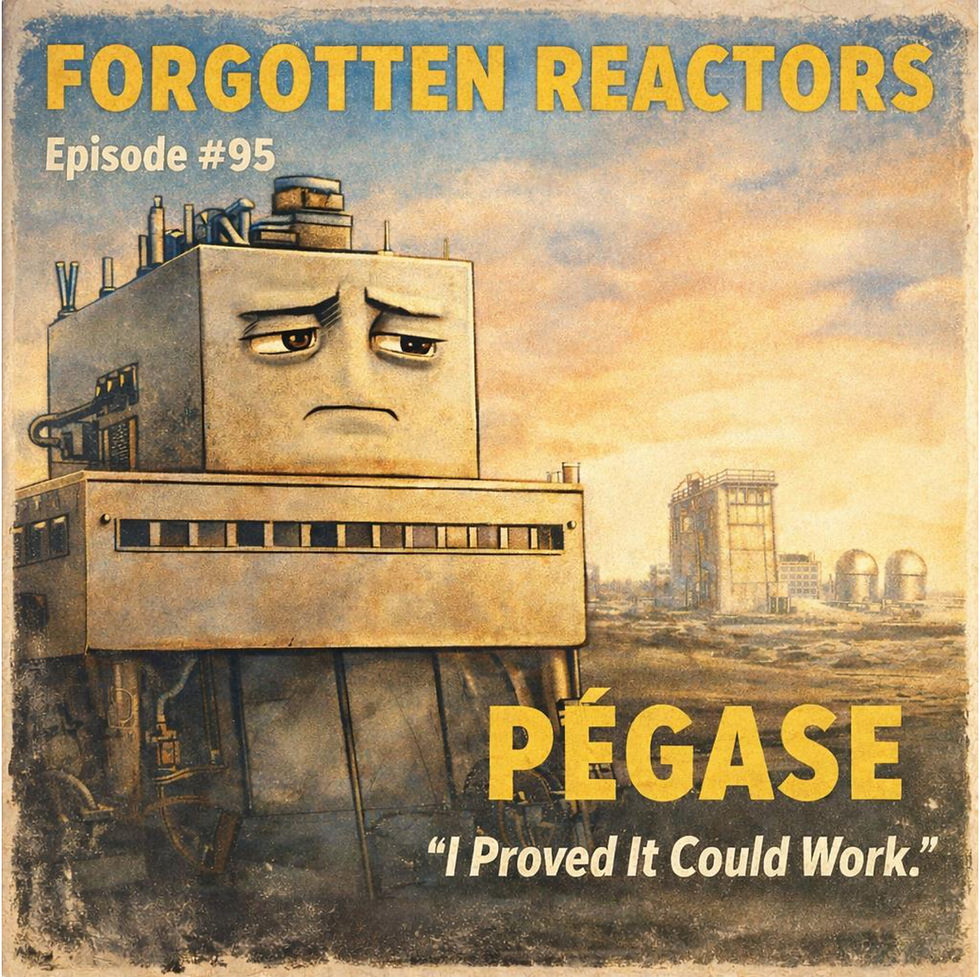
Pegase: The Loyal Workhorse of a Cancelled French Dream (Forgotten Reactors Episode #95)
Back in 1963, France had a bold plan. They wanted a nuclear fleet running on natural uranium—no enrichment plants, no begging Washington for fuel, total energy independence. That was the UNGG program: Uranium Naturel Graphite Gaz (Gas). Graphite moderator, CO2 cooling, and fuel rods made from straight-up natural uranium metal.
To pull it off, they needed to really understand how that fuel would hold up. So they built PEGASE at CEA Cadarache—a dedicated 30 MWth test reactor just to irradiate and torture-test the fuel elements headed for those power plants.
PEGASE went critical on April 4, 1963, right around the time Cadarache itself was getting its official launch.
It wasn't about making electricity or proving some flashy new concept. PEGASE was a tool—a super precise, expensive one, like a wind tunnel built for one specific plane. France was all-in on UNGG. Chinon, Saint-Laurent, Bugey... the plants were already rising. PEGASE's job was clear; make sure the fuel behaved under real neutron flux and heat.
They even had a little sister reactor, PEGGY, that came online in 1961. Zero-power critical mock-up. PEGGY handled the neutronics basics—flux maps, control rods, burnable poisons. Dress rehearsal done right. Then PEGASE fired up the heat, hitting its full 30 MWth on May 28, 1963. It kept running until 1975, gathering the data that mattered.
But here's where the story gets bittersweet. The UNGG design was solid on paper, but scaling it sucked.
Running a 500 MWe UNGG needed about as many people as a 1300 MWe PWR. The CO2 coolant wasn't perfectly chill—it reacted with the graphite, making carbon monoxide and methane that you had to scrub constantly. Temperatures got dialed back because chemistry was chewing up the hardware. Magnesium-zirconium cladding corroded. Even "online refueling" turned into a headache instead of a feature.
Meanwhile, light-water reactors were cheaper to build, easier to staff, and waaaaay simpler to sell abroad. France looked at the numbers and switched tracks. The last UNGG, at Bugey, shut down for good in 1994.
PEGASE spent over a decade perfecting fuel for a program France eventually walked away from. The engineering wasn't a flop—the data was real, the work was sharp. It just feels like a beautifully built bridge to a road that never got finished.
After 1975, they repurposed PEGASE for interim waste storage. Practical, sure, but a little undignified for what had once been such a precision instrument.
Lessons Learned:
1. Independence sounds romantic, but economics win.
Chasing self-sufficiency with natural uranium looked smart geopolitically in the '60s.
But higher staffing, tricky chemistry, and derated performance made UNGG expensive at scale.
PWRs scaled better, cost less to run, and were easier to export—France pivoted fast.
2. Test reactors are worth every franc when you're committed.
PEGASE (and PEGGY) gave rock-solid fuel data before full-scale plants were online.
That kind of targeted irradiation testing prevented nasty surprises down the line.
Even if the program died, the knowledge didn't—good engineering outlives the original plan.
3. Nothing in nuclear is forever—plan for the endgame early.
Converting PEGASE to waste storage was pragmatic, but seismic realities eventually forced decommissioning.
Big research facilities age, sites get re-evaluated, and retrofits can get prohibitively expensive.
Build flexibility and exit strategies into the design from day one.
SLIDE DECK


