


Episode:
17

BONUS BWR Puerto Rico
Country:
USA
Years of Operation:
1964-1968
Category:
Prototype & Demonstration
Reactor Type:
BWR
Coolant:
Light Water
Fuel Type:
Enriched Uranium
Moderator:
Light Water
Thermal Power (MWth):
50
Electrical Power (MWe):
50
Status:
Prototype & Demonstration
_page-0001.jpg)

timeline
First Criticality Year
1964
Commercial Op Year
1965
Shutdown Year
1968


Lessons Learned
Reliability beats cleverness. A nuclear plant isn’t a science project. If it can’t run day after day without drama, it won’t survive the balance sheet.
Engineering must serve the Operator. Efficiency gains are meaningless if they introduce complexity that keeps the CNO awake at night.
Stability is the ultimate innovation. The winners in this industry aren't the fanciest designs—they’re the ones that quietly produce power for 60 years without making the news.
sources

ARTICLE

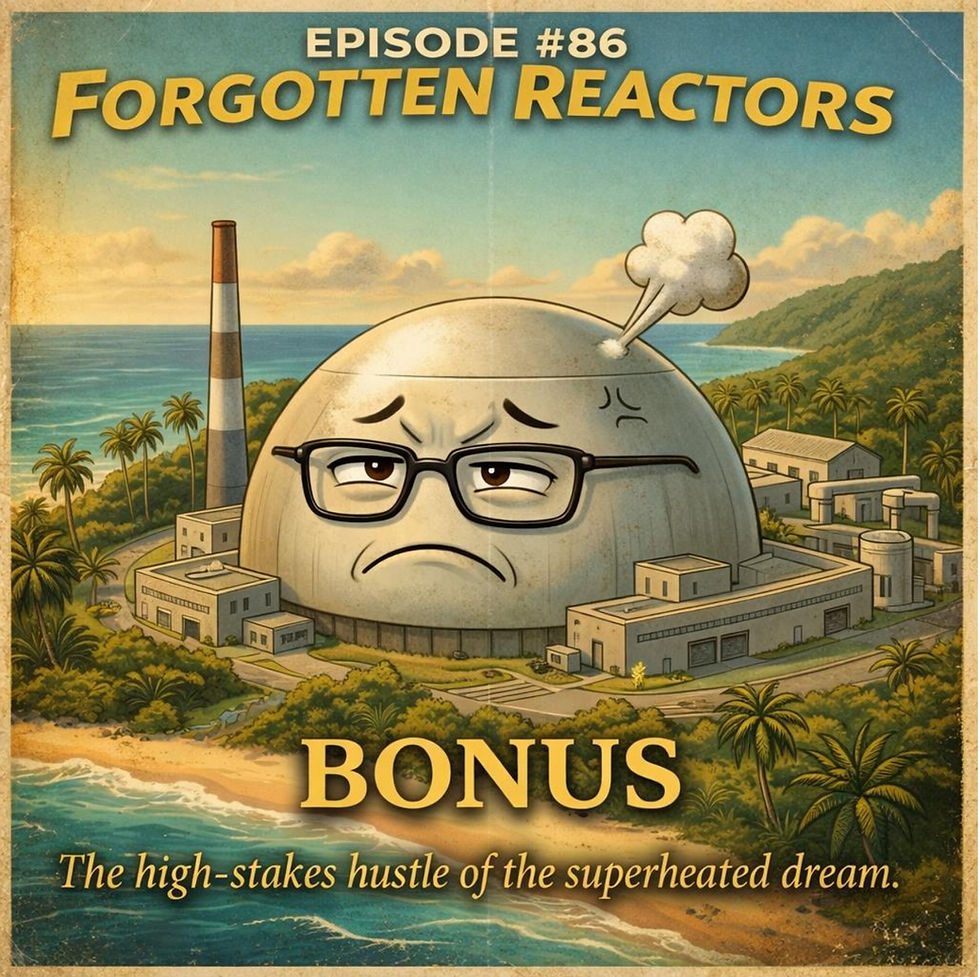
Forgotten Reactors Episode #86: The Caribbean’s Atomic Ghost
BONUS: The High-Stakes Hustle of the Superheated Dream.
South of Rincón, Puerto Rico—tucked behind surf breaks and palm trees—sits a lonely concrete dome that once symbolized the atomic future of the Caribbean. Today, it’s a quiet relic. But in the early 1960s, that dome housed one of the most ambitious nuclear experiments ever attempted.
Its name was fittingly optimistic: BONUS (the BOiling NUclear Superheater).
The "Clever" Concept
Construction began in 1960. By 1964, Puerto Rico had joined the nuclear club. The engineering goal was seductive: take a conventional light-water reactor and add a superheater inside the same pressure vessel. By pushing steam temperatures higher, engineers hoped to squeeze 5–10% more efficiency out of the turbine.
On paper, it was brilliant. In the field, it was a reminder that physics doesn’t care about your PowerPoint deck.
The Reality Check
BONUS was a 50 MWth reactor (17 MWe) using a Westinghouse core. The "bonus" was a superheater region built directly into the vessel—an engineering juggling act where two vastly different thermal environments had to coexist.
Same coolant.
Same pressure vessel.
Violently different physics.
Managing the boiling section and the superheater section under load changes was like trying to conduct a symphony where half the musicians were playing jazz and the other half were playing Beethoven. Operators quickly realized that controlling BONUS wasn't like driving a car; it was like balancing a broomstick on your fingertip while riding a bicycle downhill.
The Ross Zinger: The history of nuclear energy is littered with reactors that were brilliant on a chalkboard and miserable in a control room.
The Verdict
By 1968, the experiment was over. Superheater tubes corroded, neutron flux gradients were a nightmare, and reliability never touched commercial requirements. The industry stepped back and admitted something vital: Sometimes clever engineering solves problems nobody actually had.
Lessons for the Next Generation:
Reliability beats cleverness. A nuclear plant isn’t a science project. If it can’t run day after day without drama, it won’t survive the balance sheet.
Engineering must serve the Operator. Efficiency gains are meaningless if they introduce complexity that keeps the CNO awake at night.
Stability is the ultimate innovation. The winners in this industry aren't the fanciest designs—they’re the ones that quietly produce power for 60 years without making the news.
The dome still stands near Punta Higuero today—a monument to 1960s optimism and a reminder that the most important feature of any reactor is how reliably it runs on Monday morning.
#NuclearEnergy #PowerGeneration #Engineering #EnergyHistory #ForgottenReactors #HadronEnergy
SLIDE DECK


